When a child with hearing loss joins a music program, the goal is often much bigger than learning songs. Music can help children become more comfortable with sound, strengthen listening skills and build confidence in communication. For many children, music becomes a natural and enjoyable way to practice hearing.
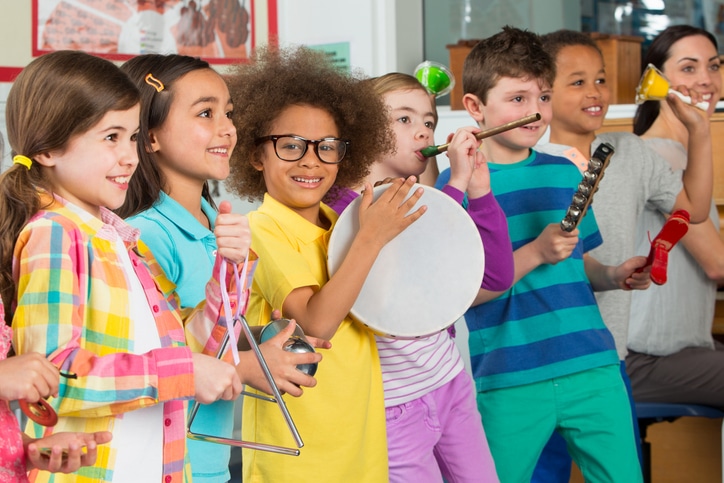
At Heuser Hearing Institute, music is woven into the learning experience because sound, rhythm and interaction can support growth across many developmental areas. Through the school’s Arts Program, children participate in music therapy sessions designed to support communication, focus and listening in ways that feel engaging rather than clinical.
Auditory Training Through Music
Board-certified music therapists often start by helping children notice and identify sounds. This might include listening games, instrument matching or activities that encourage children to distinguish between loud and soft sounds, fast and slow rhythms or different musical tones.
This helps children learn that sounds have meaning. Over time, those listening skills begin to carry into conversations, classrooms and daily routines.
Research published in the Journal of Speech, Language, and Hearing Research found that after a 12-week music training program, “perception of speech-in-noise, question/statement prosody, musical timbre, and spectral resolution improved significantly” in participating children with hearing loss.1
Active Listening and Speech Perception
Music gives children repeated opportunities to listen carefully and respond. A therapist may sing a simple phrase and encourage a child to repeat it, clap a rhythm or identify a sound source.
These activities help strengthen skills related to:
- Detecting speech patterns
- Recognizing changes in pitch and timing
- Following spoken directions
- Listening in more complex environments
That foundation can support both language development and everyday communication.
Building Social Connections Through Music
Music therapy is rarely a solitary activity. Children often participate together, practicing turn-taking, shared attention and cooperation.
A 2023 study examining music-based auditory training quoted one pediatric cochlear implant user who said music remained “a valued source of enjoyment, emotional regulation, and social connection.“2 Those benefits matter because communication success is not only about hearing sounds. It’s also about feeling connected to other people.
For families throughout Greater Raleigh and the Research Triangle, structured music experiences can provide another meaningful way to encourage social growth alongside listening development.
Why Music Therapy Often Works So Well
Children tend to stay engaged when learning feels fun. Music combines movement, listening and communication in a way that naturally captures attention.
A music therapist may:
- Incorporate singing, movement and instruments into sessions
- Align activities with classroom or individual learning goals
- Gradually introduce new listening challenges
- Reinforce successful listening behaviors through play
What Do Children Often Notice First?
Many children first become more aware of everyday sounds. They may notice musical patterns, environmental noises or changes in a speaker’s voice that previously went unnoticed.
Does Music Therapy Replace Other Services?
No. Music therapy is generally used alongside hearing technology, speech-language services and educational support to reinforce communication and listening skills in a different setting.
Helping Your Child Explore Music This School Year
The return to school often brings new routines and new opportunities. Music programs can be one of them.
If you’re curious about how music can support your child’s listening, communication and confidence, Heuser Hearing Institute can help you learn more about available services and educational opportunities. Sometimes the path to better listening starts with something as simple as a song.
Sources
1 Lo, C. Y., Looi, V., Thompson, W. F., & McMahon, C. M. “Music Training for Children With Sensorineural Hearing Loss Improves Speech-in-Noise Perception.” Journal of Speech, Language, and Hearing Research. https://www.researchgate.net/profile/William-Thompson-43/publication/342219391_Music_Training_for_Children_With_Sensorineural_Hearing_Loss_Improves_Speech-in-Noise_Perception
2 Gfeller, K., & Mallalieu, R. “Psychosocial and Auditory Factors That Influence Successful Music-Based Auditory Training in Pediatric Cochlear Implant Recipients.” Frontiers in Human Neuroscience. https://www.ncbi.nlm.nih.gov/pmc/articles/PMC10764544/